Jumper’s Knee, Ankle Sprains: Volleyball Injury Risks. The Data on ACL Risk, Shoulder Overuse, and Prevention.
Emma was sixteen the first time she rolled her ankle at the net. She came down from a block onto a teammate’s foot and felt the joint give way. She sat on the court for a full minute before she could stand. Two weeks of rest and a brace later, she was back. Three months after that it happened again, on the same ankle, during a routine defensive shuffle. Her physical therapist told her something that surprised her. The second sprain was not bad luck. It was the most predictable outcome in her sport, and one of the best-studied problems in all of sports medicine.
Volleyball has a reputation as a safe, non-contact alternative to soccer or basketball. The data tell a more specific story. Jumping, blocking and landing, often on another player’s foot, create a small set of injury patterns. Those patterns repeat in youth leagues, recreational clubs and the professional game. Recent systematic reviews now map them with real precision: which body parts absorb the load, which movements cause the trouble and which interventions actually change the numbers.
How common are volleyball injuries, really?
A 2017 systematic review published in the European Journal of Sport Science is the closest thing volleyball medicine has to a master reference. It pooled the available research on how often injuries happen, why they happen and how to prevent them. Injury rates ranged from 1.7 to 10.7 injuries per 1,000 playing hours. Injuries were more frequent in matches than in training, and more frequent in men than in women.
What does 1.7 to 10.7 injuries per 1,000 hours mean in real life? Picture a club team of 12 players who each train and play 6 hours a week. That adds up to 72 hours a week, or about 2,900 hours over a 40-week season. At those rates, the team could expect somewhere between 5 and 31 injuries in one season.
The same review named the ankle, the knee and the shoulder as the three most commonly injured sites. It split injuries into two groups. Acute injuries come from a single bad landing. Overuse injuries build slowly from thousands of jumps and overhead hits.
Age changes the picture. A 2023 systematic review focused on young volleyball athletes aged 12 to 18 found incidence ranging from 1.51 injuries per 1,000 player hours to 12.4 injuries per 10,000 athlete exposures across five studies. An athlete exposure is one practice or one match. Overall prevalence was 1.6 injuries per 100 athlete exposures.
Where young players get hurt, according to the 2023 review:
- Ankle: 20 to 37 percent of injuries, depending on the study.
- Hand, wrist and fingers: 16 to 18 percent, often from blocking.
- Knee: 14 to 15 percent.
Older teens had higher injury rates than younger ones. Junior volleyball players, overall, were injured less often than juniors in several other high school sports. Girls make up a large share of youth volleyball, and their injury patterns deserve specific attention. I cover that topic in my article on sport trauma in female athletes.
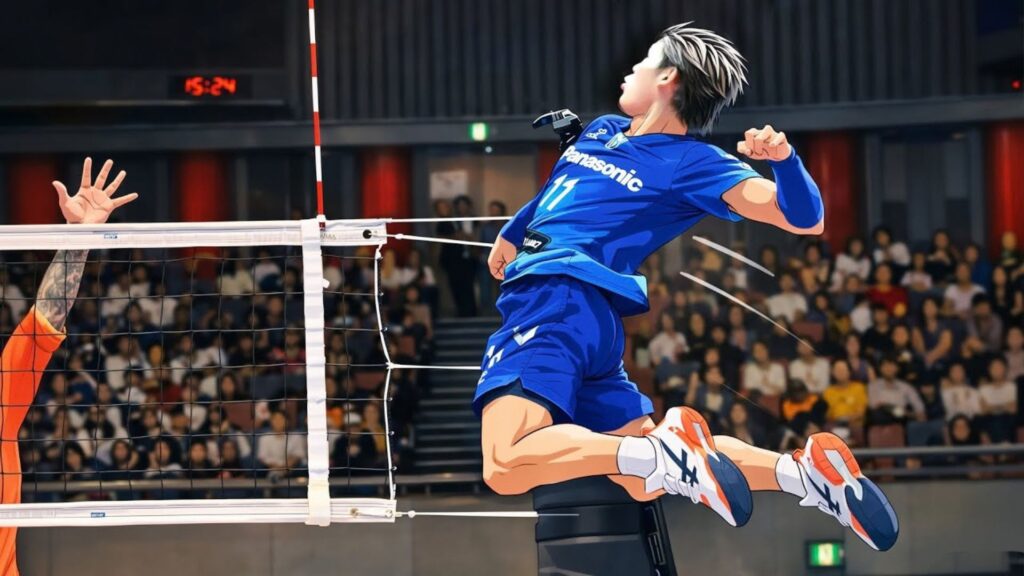
One detail stands out across both reviews. The ankle leads by a wide margin, even though volleyball has almost no direct contact with opponents. The mechanism is nearly always the same. A player jumps to block or attack near the net and lands on another player’s foot instead of the floor.
The 2017 review also found that overuse injuries, mostly in the knee and shoulder, are often underreported. Players keep competing through early symptoms instead of seeking care. The same review found very few high-quality studies on shoulder injury prevention, a gap the field is only starting to close.
Ankle sprains: volleyball’s signature injury
Ankle sprains are the most common injury in volleyball. They are also one of the most successfully prevented. The usual type is a lateral ankle sprain: the foot rolls inward and the ligaments on the outer side of the ankle stretch or tear. In volleyball this typically happens when a player lands on someone else’s foot under the net, with full body weight coming down.
Why does this happen so often? Under the net, the two teams are separated only by the center line. An attacker who drifts forward, or a blocker who lands slightly past the line, can come down on an opponent’s foot. Two teammates landing side by side after a double block create the same risk on their own side.
The prevention evidence is strong. A meta-analysis on neuromuscular training in sporting populations found that structured programs reduced the risk of ankle sprain by 40 percent. When the authors broke the results down by sport, volleyball stood out. Every volleyball study in the analysis showed a significant drop in sprains. The effect was more consistent than in soccer, basketball or handball.
The 2017 review adds a real-world example from Dutch volleyball. A structured prevention program lowered ankle sprain incidence from 0.9 injuries per 1,000 playing hours in year one to 0.5 by year three. That is close to half.
What does neuromuscular training look like on court? It is balance work, landing practice and proprioceptive drills. Proprioception is the body’s sense of joint position. These exercises retrain the quick, automatic reflex that keeps the ankle stable when the foot lands badly. Some practical examples:
- standing on one leg on a balance board for 30 to 60 seconds, then repeating with eyes closed;
- small single-leg hops forward and sideways, holding each landing for two seconds;
- block-jump drills at the net that finish with a soft, controlled two-foot landing.
Recurrence is the real danger. A first sprain roughly doubles the risk of a second one. Repeated sprains are linked to chronic instability, the feeling that the ankle “gives way” during ordinary movement. Emma’s second injury fit this pattern exactly. An athlete who returns without training proprioception goes back to the same conditions that caused the first sprain.
Jumper’s knee: the overuse injury volleyball owns
If the ankle sprain is volleyball’s signature acute injury, patellar tendinopathy, known as jumper’s knee, is its overuse counterpart. A 2023 systematic review and meta-analysis on patellar tendinopathy compared athletes across many sports. Volleyball players had the highest pooled prevalence of any group, at 24.8 percent. Basketball followed at 20.8 percent, and soccer at just 6.1 percent. Among elite male volleyball players, some studies report prevalence as high as 40 to 50 percent.
The patellar tendon connects the kneecap to the shinbone. It absorbs a large force every time a player jumps to attack, block or serve, and again on every landing. Repeated thousands of times a season, that load can outpace the tendon’s ability to repair itself. The result is a slow degeneration of the tendon rather than a simple inflammation.
The same review found jumper’s knee roughly twice as common in athletes aged 18 and over as in younger ones. The authors linked this to years of accumulated jumping and to the higher training volume of elite players. Risk factors across the literature included higher body mass index, greater height, harder playing surfaces and more total playing hours. All of them point to cumulative load as the central driver.
Three practical factors appear again and again in the jumper’s knee research:
- Landing mechanics. Stiff landings, with little bend at the knee and hip, send more force straight through the tendon.
- Training volume. Players who jump more each week, from matches, practice or both, collect tendon stress faster than the tissue can adapt.
- Playing surface. Harder courts return more force to the tendon at each landing than surfaces with more give.
None of these works alone. A tall, heavy player training at high volume on a hard court collects risk from every direction at once.
How many jumps is a lot? The number varies widely by position. Setters and middle blockers usually jump far more often than defensive specialists, who rarely jump at all. A simple way to start is to count the jumps in one typical practice. Then compare that number from week to week, the same way a runner tracks weekly distance.
Jumper’s knee rarely announces itself with a dramatic moment. Athletes describe a dull ache just below the kneecap. It gets worse with jumping and eases with rest. In the early stages it is easy to play through and easy to dismiss as normal soreness. That slow onset helps explain why the condition lasts for years in many elite athletes. Long-term follow-up studies of young elite players have tracked it more than a decade after diagnosis.
Treatment is mostly about managing load and progressive strengthening of the tendon. For cases that do not respond, injection therapies are an option under study, and results vary between patients. I explain why in my article on matching platelet-rich plasma to the right injury.
ACL injuries and shoulder overuse
The other two major injury sites happen less often, but both carry long-term consequences. The anterior cruciate ligament (ACL) is one of the main stabilizing ligaments inside the knee. It stops the shinbone from sliding forward and twisting under the thigh bone.
A 2025 systematic review on ACL injuries in volleyball pooled 15 studies covering more than 3.3 million athletes aged 10 to 70. ACL injury rates varied widely with exposure time, competition level and injury mechanism. Most ACL injuries in volleyball are non-contact. They happen while landing from a jump, not from a collision. That places them in the same family as ankle sprains and jumper’s knee: injuries created by the sport’s own jumping and landing.
The 2025 review cited an umbrella review of injury-prevention research. It concluded that neuromuscular training is one of the most consistently effective strategies for reducing injury risk in athletes. That training combines plyometrics (jump training), balance work, strength training and technique correction. The authors added that sport-specific versions improve both adherence and real-world results. This connects back to the ankle data. The same broad type of training seems to protect several joints at once.
Technique correction usually targets the landing itself. Players learn to land softly on both feet, with knees and hips bent and the knees pointing over the toes. In clinical practice, the pattern we watch most closely is a knee that collapses inward at landing. It is easy to spot on a phone video filmed from the front, and it is trainable.
An ACL tear usually means surgery and many months away from the court. The return is often harder than the operation itself. Players need to regain strength, confidence and landing control before competing again. Many of the same questions apply after other knee procedures, as I discuss in my article on returning to sport after cartilage surgery.
Shoulder overuse follows the familiar pattern of overhead sports. Attacking and serving both require repeated, forceful overhead arm motion. The rotator cuff and the muscles that stabilize the shoulder blade absorb small amounts of damage across a season. Tennis, handball and baseball show the same process. The first sign is often pain at the top or front of the shoulder while serving or spiking, which fades with rest. Later it can appear during the warm-up or even at night.
Systematic reviews on overhead athletes point to three main predictors of future shoulder problems: reduced range of motion, a previous injury and the total volume of repetitions. The dominant hitting shoulder is almost always the one affected. Reported shoulder pain in volleyball players varies between roughly 9 and 40 percent, depending on age and level. That spread is wide enough that researchers have asked for more standardized reporting.
One review focused only on indoor volleyball, instead of mixing it with other overhead sports. The goal was to separate true volleyball risk factors from findings borrowed from tennis or handball. The distinction matters in the clinic. A handball player’s shoulder faces different timing and load direction from a volleyball attacker’s. Two findings came up repeatedly: reduced internal rotation of the dominant shoulder and poor control of the shoulder blade. Internal rotation is the ability to turn the arm inward. Both can be screened before symptoms start, not only after pain appears.
A practical example: a physiotherapist can measure internal rotation in both shoulders at the start of the season. A clear loss on the hitting side is a reason to add targeted stretching and rotator cuff strengthening early, before the heavy match period begins.
What actually prevents volleyball injuries
The most useful finding in this research is not the list of things that go wrong. It is that a small set of interventions works again and again. It works for the ankle and the knee, and to a lesser extent the shoulder.
Neuromuscular and proprioceptive training has the strongest evidence. It cut ankle sprain risk by 40 percent across sports, and volleyball showed the most consistent benefit. The same type of training, with a focus on jumping and landing, also protects the knee ligaments, according to the umbrella review cited in the ACL research. Similar programs have transformed prevention in other sports too. I describe one clear example in my article on the science of hamstring injury prevention.
Structured programs beat one-off warm-ups. The Dutch data, with sprains falling from 0.9 to 0.5 injuries per 1,000 hours over three years, came from a program built into regular training for full seasons. It was not a single preseason session. Consistency seems to matter more than intensity. Ten minutes at every practice, repeated for 30 or 40 weeks, adds up to far more training than an intense two-week block in August.
Managing total jump load protects the knee. Jumper’s knee tracks closely with playing hours, height and body mass. All of these describe how much load the tendon absorbs over time. That gives coaches a lever they can actually pull. They can count weekly jumps and reduce practice volume when match load piles up.
Here is what this looks like for a club team with two practices and one match a week:
- ten minutes of balance and landing drills at the start of every practice, all season long;
- fewer high-volume jumping drills in weeks with a tournament or two matches;
- a return-to-play plan after any ankle sprain that includes balance training, not just rest.
None of this requires special equipment. A balance board costs little, and single-leg exercises need no equipment at all. The harder part is keeping the routine going in October, February and April, when the season is busy and the drills feel repetitive. That is exactly when they count.
Prevention works best when it starts young. Youth programs across many sports have shown what well-designed warm-ups can do, a topic I cover in my article on injury prevention programs in youth sports.
The evidence still has gaps worth naming. The 2017 review stated that effective prevention measures remain scarce outside the ankle and knee. It called for more research on shoulder injuries, where high-quality prevention trials are still lacking. The ACL review reached a similar conclusion from another angle. Injury rates varied so much between studies that pooling them into a single number would be misleading. The prevention principles, however, appear to transfer well between joints.
Quick reference for players and coaches
- Build neuromuscular and balance training into every warm-up, not just the preseason.
- Track weekly jump volume across matches and practice, and cut practice load in heavy match weeks.
- Treat a first ankle sprain as a signal to train proprioception, since a second sprain is far more likely without it.
- Watch for pain just below the kneecap during or after jumping, the first sign of jumper’s knee.
- Screen shoulder range of motion regularly in players who attack or serve a lot, since a measurable loss tends to come before pain.
What Emma’s ankle shows about volleyball injuries
The research draws a clear picture. The ankle, the knee and the shoulder account for most volleyball injuries. The ankle sprain usually comes from landing on another player’s foot. Jumper’s knee affects 24.8 percent of volleyball players, more than in any other sport studied. Most ACL injuries happen without contact, during landing. Shoulder problems build slowly in the hitting arm. Overuse injuries in the knee and shoulder are often underreported, because players keep competing through the early warning signs.
The same research points to a short list of solutions. Neuromuscular training cut ankle sprain risk by 40 percent. A structured program nearly halved sprains over three seasons. Counting jumps and adjusting practice load protects the patellar tendon.
Emma’s ankle held up for the rest of that season and the next one. Her physical therapist replaced simple rest with a structured neuromuscular program. Nothing about her case was unusual. She had a predictable mechanism and a well-studied intervention. Her outcome depended less on natural resilience than on someone applying what the evidence already shows.
If you coach or play, start with the easiest change. Add ten minutes of balance and landing drills to your next practice, and keep them there all season.
References
- Kilic O, Maas M, Verhagen E, Zwerver J, Gouttebarge V. Incidence, aetiology and prevention of musculoskeletal injuries in volleyball: a systematic review of the literature. Eur J Sport Sci. 2017;17(6):765-93.
- de Azevedo Sodré Silva A, Sassi LB, Martins TB, de Menezes FS, Migliorini F, Maffulli N, Okubo R. Epidemiology of injuries in young volleyball athletes: a systematic review. J Orthop Surg Res. 2023;18:748.
- Sassi LB, Miguel AC, Serafim TT, de Menezes FS, Martins TB, Okubo R. Understanding ACL injuries in volleyball: a systematic review of epidemiology and risk factors. Front Sports Act Living. 2025;7:1675136.
- Nutarelli S, Mondini Trissino da Lodi C, Cook JL, Deabate L, Filardo G. Epidemiology of patellar tendinopathy in athletes and the general population: a systematic review and meta-analysis. Orthop J Sports Med. 2023;11(6).
- Vriend I, Gouttebarge V, Van Mechelen W, Verhagen EALM. Neuromuscular training is effective to prevent ankle sprains in a sporting population: a meta-analysis translating evidence into optimal prevention strategies. J ISAKOS. 2016;1(4):202-13.
© 2026 Marcus Valladares Guimarães. All rights reserved.This site is proudly created with WordPress.