Ultra-Processed Foods: Hidden Health Risks Revealed.
How UPF Diet Drives Chronic Disease and Weight Gain
Every day, millions of Americans reach for foods wrapped in colorful packaging: chips, soft drinks, instant noodles, flavored yogurts, breakfast cereals. These are ultra-processed foods (UPF) and they now account for nearly 60% of calories consumed in the United States. They are convenient, cheap and engineered to taste irresistible. But the latest science paints a troubling picture.
A landmark 2024 umbrella review published in the BMJ analyzed data from over 9.9 million people across dozens of countries and found convincing evidence linking ultra-processed foods to heart disease, type 2 diabetes, depression, obesity and even early death. A second major review published in Clinical Nutrition in 2024 expanded these findings to 25 different health outcomes.
The science is clear: ultra-processed foods are not just empty calories. They are a driver of the modern chronic disease epidemic. In this article, you will learn what ultra-processed foods really are, what they do to your body, and how to make smarter choices, without giving up flavor or convenience.
What Are Ultra-Processed Foods?
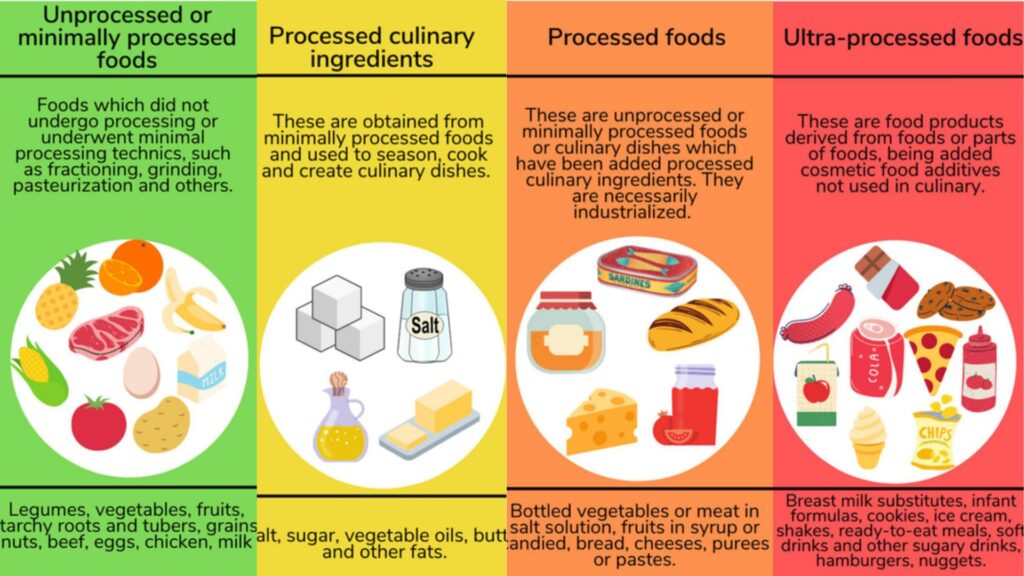
To understand the health risks, you first need to understand what makes a food “ultra-processed.” The answer lies in the NOVA classification system, developed by researchers at the University of São Paulo, Brazil. NOVA divides all foods into four groups based on the degree of industrial processing.
Here is how the NOVA groups break down:
- Group 1 — Unprocessed or minimally processed foods: Fresh fruits, vegetables, plain meats, eggs, milk. Natural or minimally altered.
- Group 2 — Processed culinary ingredients: Oils, butter, sugar, salt, flour. Used in cooking, derived from Group 1 foods.
- Group 3 — Processed foods: Canned vegetables, cheese, cured meats. Combine Groups 1 and 2, mainly for preservation.
- Group 4 — Ultra-processed foods (UPF): Industrial formulations made mostly from food extracts and chemical additives, with little or no whole food.
What separates UPF from “processed” food is the ingredient list. Terms like high-fructose corn syrup, hydrogenated oils, artificial flavors, emulsifiers (such as carrageenan or xanthan gum), colorings and preservatives signal an ultra-processed product. These substances are added not to nourish you, but to make food last longer, look better and feel impossible to stop eating.
Common ultra-processed foods include:
- Soft drinks, energy drinks and flavored waters
- Packaged snacks: chips, cookies, crackers and pretzels
- Instant noodles, soups and pre-made sauces
- Flavored breakfast cereals and granola bars
- Fast food items and frozen ready meals
- Processed meats: hot dogs, nuggets and flavored sausages
- Packaged breads, pastries and flavored yogurt
In the United States, ultra-processed foods account for approximately 58% of daily caloric intake among adults and nearly 67% among children. The food industry designs these products to be hyperpalatable — triggering pleasure and reward signals in the brain more intensely than whole foods. Salt, sugar and fat in precise combinations activate dopamine pathways, making it genuinely difficult to stop eating. Understanding this is not about blame; it is about empowerment through knowledge.
The Disease Connection: What Research Shows
The 2024 BMJ umbrella review by Lane et al. is one of the most comprehensive analyses of ultra-processed food research ever conducted. It examined meta-analyses covering over 9.9 million people from dozens of countries, evaluating the relationship between UPF consumption and dozens of health outcomes. The evidence was organized into four categories by strength: convincing (Class I), highly suggestive (Class II), suggestive (Class III) and weak (Class IV).
The findings were striking. Higher ultra-processed food intake was associated with:
- Cardiovascular disease: Convincing evidence linked UPF consumption to higher rates of cardiovascular disease, coronary heart disease and cardiovascular mortality.
- Type 2 diabetes: Strong associations between regular UPF consumption and development of type 2 diabetes, a disease now affecting over 37 million Americans.
- Mental health: Convincing evidence that UPF consumption associates with higher rates of depression and anxiety — partly explained through the gut-brain axis.
- Obesity and metabolic disease: Strong links to overweight, obesity, abdominal fat accumulation and metabolic syndrome. Our article on metabolic syndrome covers these connections in depth.
- Cancer: Emerging evidence suggested associations with colorectal and breast cancer.
- All-cause mortality: Higher UPF intake was associated with significantly increased risk of dying from any cause.
A companion 2024 review in Clinical Nutrition confirmed and expanded these findings, identifying 18 new health outcomes including inflammatory bowel disease, poor sleep quality, and kidney disease. Taken together, these reviews shift our understanding of dietary risk. It is not just about calories or fat in isolation, the industrial nature of ultra-processed food itself is harmful.
Why Ultra-Processed Foods Are So Hard to Avoid
Knowing these foods are harmful does not automatically make them easy to avoid. Several powerful forces make them the default choice for hundreds of millions of people.
Price and accessibility. In most American cities, a bag of chips costs less than a single apple. Fresh produce, whole grains and unprocessed proteins are often more expensive and require more preparation time. This creates a genuine barrier, particularly for lower-income families.
Engineered addictiveness. Ultra-processed foods are specifically designed to override normal satiety signals. The combination of fat, salt and refined sugars creates a “bliss point” that makes it easy to overeat. Brain imaging studies show that eating UPF activates reward circuits similarly to addictive substances.
Time pressure and convenience. Most working adults and parents do not have 45 minutes to cook dinner every night. Ultra-processed food fills a real gap in the daily schedule.
Misleading marketing. The food industry spends billions annually on advertising, including to children. Many products are marketed as “healthy”, “natural” or “high-protein”, while their ingredient lists tell a very different story.
Food deserts. In many American communities, access to fresh, whole food is genuinely limited. Convenience stores and fast food restaurants are everywhere; fresh grocery stores are miles away.
Understanding these barriers is essential. Public health solutions require systemic change: food labeling reform, taxes on ultra-processed products (already implemented in several countries) and urban planning that improves food access. Our article on the 2025 Dietary Guidelines explores how science-based recommendations are often overridden by industry influence.
The Scale of the Crisis: Numbers That Should Alarm You
In the United States, ultra-processed foods account for 57–58% of total daily caloric intake among adults and nearly 67% among children and adolescents. According to data from the National Institutes of Health, this shift toward UPF consumption began accelerating in the 1980s and has continued without interruption.
The adult obesity prevalence in the US now exceeds 42%, with projections suggesting over 50% of adults will be obese by 2030. While obesity has multiple causes, the scientific consensus points to ultra-processed food as a major driver, both through caloric density and through disruption of appetite hormones like leptin and ghrelin.
Type 2 diabetes affects 37 million Americans and costs the healthcare system over $412 billion annually. Heart disease remains the leading cause of death. Depression affects over 21 million American adults. All three show robust associations with ultra-processed food intake in large-scale meta-analyses.
Globally, low- and middle-income countries are experiencing rapid transitions toward Western dietary patterns. Brazil, Mexico, Chile and many Asian countries are seeing obesity and diabetes rates surge in parallel with rising UPF consumption.
KEY FACT: The Global Burden of Disease Study estimates that poor diet kills more people worldwide each year than tobacco, making dietary reform one of the most powerful public health interventions available.
What exactly is driving the harm? Researchers have documented several key biological mechanisms:
- Displacement of nutritious foods: Every UPF calorie replaces fiber, vitamins, minerals and phytonutrients that the body needs.
- Emulsifiers and gut permeability: Common emulsifiers like polysorbate 80 and carboxymethylcellulose disrupt the gut microbiome and promote low-grade inflammation.
- Neuroendocrine disruption: UPF consumption interferes with hunger and satiety hormones, making it harder to recognize fullness.
- Rapid glycemic impact: Most UPF are low in fiber and high in refined carbohydrates, causing blood sugar spikes that trigger further hunger and overeating.
Diets like the Mediterranean diet, rich in whole foods, olive oil, legumes, vegetables, and lean protein, represent the nutritional antithesis of the ultra-processed food pattern, and consistently show the opposite health outcomes in population studies.
Practical Steps to Reduce Ultra-Processed Food in Your Diet
The good news is that you do not need a perfect diet to see real health benefits. Research shows that even modest reductions in UPF intake can meaningfully improve metabolic markers, mood, weight and cardiovascular risk.
Here are seven evidence-based strategies to start today:
- Read ingredient lists, not just nutrition facts. Nutrition labels tell you calories and fat. Ingredient lists tell you what is actually in the food. If you see more than five ingredients, or ingredients you cannot pronounce, it is likely a UPF. Watch for: partially hydrogenated oils, high-fructose corn syrup, artificial colors and emulsifiers.
- Apply the NOVA framework at the grocery store. Before putting something in your cart, ask: “Was this made in a kitchen or a factory?” Fresh produce, eggs, plain meats and plain dairy are Groups 1-3. Packaged snacks, flavored drinks and instant meals are almost always Group 4.
- Cook in batches. Batch cooking on Sunday, preparing grains, proteins and roasted vegetables for the week, makes it far easier to eat whole food on busy weeknights. A pot of rice, roasted chicken and chopped vegetables takes 45 minutes and feeds a family for three days.
- Swap strategically, not dramatically. Trying to overhaul your entire diet overnight creates resistance and failure. Instead, make one swap per week. Replace morning cereal with plain oatmeal. Trade soda for sparkling water with lemon. Swap chips for mixed nuts. Small, sustained changes produce large results.
- Be wary of “healthy” ultra-processed foods. Protein bars, low-fat yogurts, plant-based meat substitutes and “natural” flavored waters often contain long ingredient lists packed with additives. Check the ingredients, not the front-of-package marketing language.
- 10.Prioritize protein and fiber at every meal. Both increase satiety, reduce overeating, and slow glucose absorption. Meals built around eggs, lentils, salmon or plain Greek yogurt with vegetables and whole grains leave you fuller for longer and dramatically reduce the urge to snack on UPF.
- 11.Make the healthier choice the easier choice. Keep fruit, nuts and pre-cut vegetables at eye level in the fridge. Remove packaged snacks from sight. Behavioral nutrition research consistently shows that people eat what is most convenient and visible.
If you are concerned about weight management and not seeing results through dietary changes alone, it is worth knowing that the medical landscape has also shifted. Our article on anti-obesity medications and GLP-1 drugs explains how these treatments work and who might benefit from them.
Conclusion
Ultra-processed foods are one of the most pressing public health challenges of our time. The 2024 BMJ umbrella review, covering 9.9 million people across dozens of countries, leaves little room for doubt: consistent consumption of ultra-processed foods meaningfully links to heart disease, diabetes, depression, obesity, cancer and early death.
None of this means you need to eliminate all processed food from your life. Occasional enjoyment of your favorite snack will not determine your health trajectory. What matters is the overall pattern, the proportion of your diet that comes from real, minimally processed foods versus industrial formulations.
Knowledge is power. Now that you understand the NOVA classification, you can read labels differently. Now that you understand the mechanisms, disrupted satiety hormones, gut microbiome damage and addictive formulation, you can make more intentional choices.
The healthiest diets in the world are not built on restriction. They are built on abundance: vegetables, fruits, whole grains, legumes, nuts, fish and lean protein. Making these foods central to your plate is not a sacrifice, it is an investment in the longest, healthiest version of your life.
Start with one change this week. Then another the week after. Over time, those changes compound into a dramatically healthier way of eating.
References
1. Lane MM, Gamage E, Du S, Ashtree DN, McGuinness AJ, Gauci S, et al. Ultra-processed food exposure and adverse health outcomes: umbrella review of epidemiological meta-analyses. BMJ. 2024;384:e077310. doi:10.1136/bmj-2023-077310
2. Marino M, Puppo F, Del Bo C, Vinelli V, Riso P, Porrini M, et al. Ultra-processed foods and human health: an umbrella review and updated meta-analyses of observational evidence. Clin Nutr. 2024;43(6):1359-74. doi:10.1016/j.clnu.2024.04.033
3. Monteiro CA, Cannon G, Levy RB, Moubarac JC, Louzada ML, Rauber F, et al. Ultra-processed foods: what they are and how to identify them. Public Health Nutr. 2019;22(5):936-41.
4. National Institutes of Health. Dietary patterns and health outcomes [Internet]. Bethesda: NIH; 2024 [cited 2026 Mar 11]. Available from: https://www.nih.gov
5. GBD 2019 Risk Factors Collaborators. Global burden of 87 risk factors in 204 countries and territories, 1990-2019: a systematic analysis for the Global Burden of Disease Study 2019. Lancet. 2020;396(10258):1223-49.
© 2026 Alice & Marcus Guimarães. All rights reserved.This site is proudly created with WordPress.