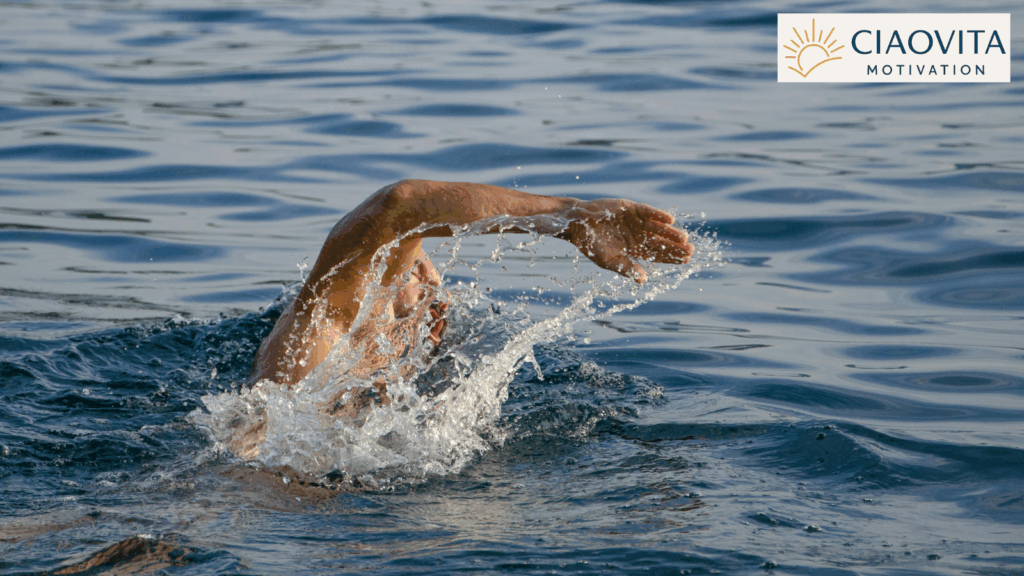
Swimming and Strength Training: The Complete Performance Guide
How Building Power Transforms Your Swimming Performance
Most swimmers believe more pool time is the answer to faster performances. They’re wrong about what really creates breakthroughs. While water work remains essential, new research reveals that strategic strength training produces performance improvements that hours of extra swimming cannot match. The science is clear: building maximum strength through classic exercises like squats and bench press transforms swimming speed, power and injury resilience in ways that “swimming-specific” training never will.
The Strength Training Revolution in Swimming
Swimming performance depends heavily on the ability to generate force against water resistance. Recent systematic reviews analyzing 338 adolescent swimmers across 16 studies confirm that resistance training significantly improves competitive swimming at all distances from 50 to 400 meters. The relationship between strength and speed is straightforward: stronger muscles produce more powerful strokes, which creates faster swimming.
The breakthrough finding challenges conventional wisdom. Researchers comparing high, moderate and low training volume-loads discovered something remarkable. All three approaches produced identical improvements in both strength and swimming performance. Swimmers training with low volume achieved the same 38% increase in bench press strength and 55% improvement in leg extension as those following high-volume programs. Swimming performance improved dramatically across all groups, with 50-meter times showing effect sizes of 1.97 standard deviations.
This reveals a critical insight for competitive swimmers. More training volume does not equal better results. The intensity and quality of strength work matters far more than the total amount performed. Training at 85 to 95% of maximum strength capacity for 2 to 3 sessions weekly produces optimal adaptations without the recovery demands that interfere with pool training. Water is 784 times denser than air, creating constant resistance that demands both strength and endurance. Building the foundation of maximum strength allows swimmers to generate greater force with each stroke cycle.
Classic Exercises Beat Specific Movements
The temptation to make strength training “swimming specific” leads coaches down an ineffective path. Research demonstrates that attempting to mimic swimming movements on cable machines or unstable surfaces produces inferior results compared to traditional exercises like squats, deadlifts and bench presses. The reasoning becomes clear when examining how the nervous system develops strength.
Your central nervous system learns to activate muscles maximally through exercises where proper biomechanics allows heavy loading in stable positions. Squats performed with 85% of maximum capacity teach your nervous system to recruit motor units rapidly and coordinate muscle firing patterns effectively. This creates adaptations that transfer to swimming through the actual practice of swimming strokes in water. The transfer occurs because maximum strength provides the foundation for all power expression, regardless of the specific movement pattern.
Exercises on unstable surfaces or machines designed to replicate swimming motions suffer from a fundamental flaw. They limit the resistance that can be safely applied, which means your nervous system never experiences the high-intensity stimulation needed to build true maximum strength. Training load principles confirm that load intensity drives adaptation more powerfully than movement similarity. A swimmer who builds a 200-pound squat possesses greater potential for explosive starts and turns than one practicing “specific” movements with 50 pounds of resistance.
The research comparing resistance training methods for adolescent swimmers found that combining two types of resistance equipment produced better results than using only one. However, the key factor was not the variety of movements but rather the progression of intensity over time. Starting with basic strength development through compound movements, then advancing to maximum strength protocols, creates the neural and muscular adaptations that enhance swimming performance.
The Optimal Training Strategy
Implementing effective strength training requires understanding the progression from foundational work to maximum strength development. The first phase focuses on hypertrophy, using moderate loads of 70 to 80% of maximum for 8 to 12 repetitions per set. This builds muscle tissue that will later produce greater force. After establishing this base over 4 to 8 weeks, intensity increases to 85 to 95% of maximum for 3 to 6 repetitions.
For adolescent swimmers, the approach requires additional consideration. Studies demonstrate that low-intensity, high-speed resistance training produces excellent results without the joint stress that higher loads create in developing bodies. Young swimmers benefit most from mastering movement patterns with moderate resistance, gradually progressing intensity as physical maturity advances. The emphasis on speed of movement teaches the nervous system to generate force rapidly, which directly improves stroke rate and starting power.
Adaptations to exercise occur through specific physiological changes triggered by training stimulus. Strength training increases contractile proteins within muscle fibers, enhances neural drive to working muscles, improves coordination between muscle groups and strengthens connective tissues. These adaptations require 6 to 8 weeks to manifest, which explains why short-term studies often fail to show significant improvements. Swimmers must commit to year-round strength work, maintaining 2 to 3 sessions weekly even during competitive phases.
The 9-week intervention comparing different volume-loads revealed that all protocols improved start performance by effect sizes ranging from 1.28 to 1.46 standard deviations. Turn performance showed similar gains across groups. These improvements stem from increased rate of force development, which determines how quickly you can generate maximum power during explosive movements. Starting blocks demand you produce maximum force in under 0.5 seconds, and turn walls require similar rapid force expression. Building maximum strength provides the foundation, while the explosive nature of swimming practice itself creates the specific power transfer needed for competition.
Preventing Common Swimming Injuries
Strength training serves a crucial protective function beyond performance enhancement. Swimmers typically demonstrate lower bone mineral density than athletes in weight-bearing sports. The weightless environment of water training fails to provide the mechanical loading necessary for optimal bone development. Competitive swimmers who train extensively in pools without adequate land-based strength work often develop degenerative changes in the spine, shoulders and knees.
The shoulder represents the most frequently injured region among swimmers, with issues ranging from impingement to reduced stability. Improper use of training aids like paddles combined with high training volumes creates overuse injuries. Strength training addresses these vulnerabilities by improving joint stability through enhanced muscular control. Exercises that strengthen the rotator cuff, scapular stabilizers and core musculature create better positioning during swimming strokes, reducing abnormal stress on joint structures.
Lower back problems affect two-thirds of competitive swimmers, often associated with self-reported pain and degenerative disc changes. The repetitive rotation and extension demands of swimming strokes, particularly butterfly and breaststroke, create cumulative stress on spinal structures. Athletic performance depends on injury-free training, making prevention strategies essential. Progressive strength training starting before puberty establishes robust bone structure and muscular support that protects against overuse injuries throughout a swimming career.
Knee issues primarily occur in breaststroke swimmers due to the leg kick’s biomechanical demands. The medial collateral ligament and patellar structures experience repetitive stress that can lead to inflammation and chronic pain. Strengthening the quadriceps, hamstrings and hip muscles through exercises like squats and lunges improves knee joint stability and distributes forces more evenly across structures. Starting strength training early allows young swimmers to build the physical resilience needed to handle high training volumes safely.
Conclusion
Swimming performance reaches new levels when swimmers abandon the myth that more pool time alone drives improvement. The scientific evidence demonstrates clearly that strategic strength training using classic compound exercises produces remarkable gains in speed, power and injury resilience. Low-volume programs achieve the same results as high-volume approaches, making efficient use of training time while preserving recovery capacity. The key lies in training intensity rather than volume, focusing on building maximum strength through proven movements like squats and bench presses instead of attempting to mimic swimming motions on land.
Competitive swimmers who integrate 2 to 3 weekly strength sessions at 85 to 95% of maximum capacity will experience transformative improvements. Effect sizes approaching 2 standard deviations for 50-meter performances, combined with dramatic enhancements in starts and turns, create competitive advantages that separate champions from competitors. The foundation of maximum strength transfers to swimming through pool practice itself, requiring no special equipment or complex programming. Start building strength today, and watch your swimming performance reach new heights tomorrow.
References
- Guo W, Soh KG, Zakaria NS, Hidayat Baharuldin MT, Gao Y. Effect of Resistance Training Methods and Intensity on the Adolescent Swimmer’s Performance: A Systematic Review. Front Public Health. 2022;10:840
- Wirth K, Keiner M, Fuhrmann S, Nimmerichter A, Haff GG. Strength Training in Swimming. Int J Environ Res Public Health. 2022;19(9):5369.
- Amara S, Crowley E, Sammoud S, Negra Y, Hammami R, Gaied Chortane O, Khalifa R, Gaied Chortane S, van den Tillaar R. What Is the Optimal Strength Training Load to Improve Swimming Performance? A Randomized Trial of Male Competitive Swimmers. Int J Environ Res Public Health. 2021;18(22):11770.
© 2025 Alice & Marcus Guimarães. All rights reserved.This site is proudly created with WordPress.