Platelet-Rich Plasma in Hair Regrowth: Science-Backed Solutions
How Growth Factors and Hair Follicle Stem Cells Restore Hair
Hair loss touches more people than most realize. About 80% of white men and 40% of women experience significant hair loss before age 70. Many turn to medications like minoxidil or finasteride, but these options don’t work for everyone and don’t address the full biology of hair follicle decline. Platelet-rich plasma in hair regrowth offers a different approach — one that uses your own blood to stimulate dormant follicles and encourage new growth.
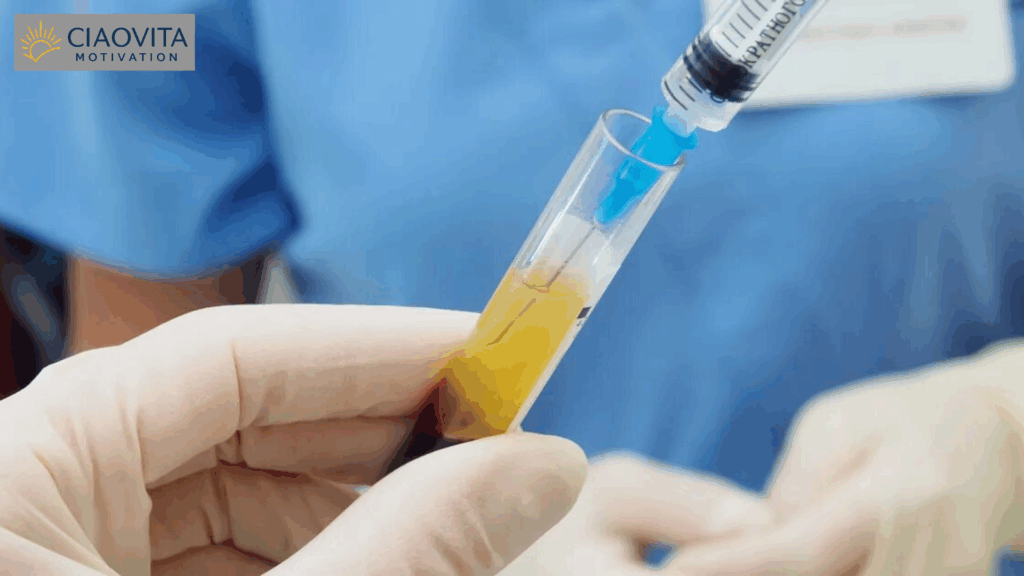
The concept sounds almost too simple. Doctors draw a small amount of your blood, spin it in a centrifuge to concentrate the platelets, then inject that platelet-rich plasma back into your scalp. Yet behind this straightforward procedure lies sophisticated biology. Your platelets release dozens of growth factors that signal hair follicle cells to survive, divide, and grow. Multiple clinical trials now confirm this treatment delivers real, measurable improvements in hair density. This article explains how it works, what the research shows, and what you should realistically expect.
What makes platelet-rich plasma work for hair
Your blood contains three main components: red blood cells that carry oxygen, white blood cells that fight infection, and platelets that drive wound healing. Platelets store tiny protein packages called alpha-granules. When activated, platelets release these packages, flooding the surrounding tissue with growth factors — signaling molecules that tell nearby cells to multiply, survive, and rebuild damaged structures.
For hair regrowth, several growth factors stand out. Fibroblast growth factor 7 (FGF-7) helps extend the anagen phase, which is the active growing period of each hair. The anagen phase normally lasts 2 to 7 years, but in androgenic alopecia — the medical term for pattern baldness — it progressively shortens. FGF-7 counteracts this shortening. Vascular endothelial growth factor (VEGF) improves blood flow around follicles by stimulating new blood vessel formation. Better circulation means more nutrients reach each follicle. Platelet-derived growth factor (PDGF) signals dermal papilla cells — the specialized cells at the base of each follicle that control hair growth — to multiply and activate.
Research also shows that platelet-rich plasma activates important molecular pathways inside cells. The ERK and Akt signaling pathways promote cell survival and growth. Beta-catenin signaling maintains stem cells in the follicle bulge — the reservoir of cells that regenerate the hair shaft each cycle. Studies confirm that PRP increases levels of Bcl-2, a protein that prevents programmed cell death. This matters because androgenic alopecia involves increased follicle cell death, and Bcl-2 directly counteracts this process.
To understand how stem cell principles apply more broadly in regenerative medicine, explore our complete guide to stem cells and tissue repair. The same biological mechanisms that drive healing in joints and tendons also apply to hair follicle regeneration.
KEY FACT: Platelet-rich plasma concentrates platelets to 4–6 times their normal blood levels, delivering a high-dose package of growth factors directly to where hair follicles live — approximately 5 millimeters below the scalp surface. |
Understanding hair follicle biology
To understand why platelet-rich plasma works, you need a basic picture of how hair follicles function. Each follicle cycles through three phases. Anagen is the active growth phase, lasting 2 to 7 years for scalp hair. Catagen marks a brief two-week transition when active growth stops. Telogen is the resting phase lasting about three months, after which the hair falls out and the cycle restarts.
In androgenic alopecia, this cycle breaks down in a predictable pattern. The anagen phase shortens progressively over years while the telogen phase lengthens. Follicles also miniaturize — they produce progressively thinner, shorter hairs until they eventually stop producing visible hair at all. Importantly, the follicle itself is not dead. It still exists in the scalp, but it has stopped functioning.
Hair follicle stem cells live in a structure called the bulge, located about one-third down from the skin surface. During each growth cycle, signals from the dermal papilla activate these stem cells. They divide and their daughter cells migrate downward to form the hair matrix — the zone of rapid cell division that produces the hair shaft. Studies identified these critical bulge stem cells using two markers: CD200 and CD34.
Here is an important finding from research: bald scalp still contains these hair follicle stem cells, but it lacks the CD200-rich progenitor cells needed to activate them and produce new hairs. This distinction matters enormously for treatment design. PRP and stem cell approaches aim to restore this missing activation signal, not create entirely new follicles from scratch.
The Wnt signaling pathway plays a central role in follicle cycling. Wnt proteins activate beta-catenin, which enters cell nuclei and turns on genes that drive follicle development and growth. Research confirms that platelet-rich plasma increases beta-catenin levels in laboratory-cultured dermal papilla cells. Genetic studies of baldness also identify multiple Wnt pathway genes among the risk variants for hair loss, confirming the pathway’s critical importance.
Clinical evidence for platelet-rich plasma in hair regrowth
The strongest clinical evidence comes from a randomized controlled trial with 57 patients that used a split-scalp design. Each patient’s scalp served as its own control — one half received three PRP treatments spaced 30 days apart, while the other half received saline injections. This design eliminates individual variation and makes results highly reliable.
After 12 weeks, the platelet-rich plasma side showed a 31% increase in hair density compared to baseline. Average hair count went from 89.6 hairs in the target area to 123.2 hairs. The saline control side showed less than 1% change — hair counts actually declined slightly from 91.1 to 87.9 hairs. This contrast demonstrates a genuine treatment effect, not a placebo response.
A second study examined an innovative combination approach using micro-grafts containing hair follicle stem cells. Researchers harvested small scalp samples, processed them mechanically to release follicle stem cells without laboratory culture, and injected the resulting cell suspension back into balding areas. Patients received two treatments 60 days apart. Results measured 23 weeks after the final treatment showed 29% improvement in hair density. Placebo areas showed no significant change.
Another finding from this research concerns the method of platelet activation. One group received PRP activated with calcium before injection. Another received non-activated PRP, allowing the body’s natural thrombin — a clotting protein present at the injection site — to activate platelets after injection. The non-activated group showed a 31% density increase versus 19% for the calcium-activated group at three months. This difference suggests that allowing the body’s own mechanisms to activate platelets produces more efficient and sustained growth factor release.
For a broader picture of how PRP performs in other medical applications, read our complete guide to PRP for joint pain and sports injuries. The same growth factor mechanisms active in hair regrowth also accelerate healing in tendons, cartilage, and bone.
CLINICAL RESULTS SUMMARY: Standard PRP (3 monthly sessions): 31% hair density increase at 12 weeks. PRP + hair follicle stem cells (2 sessions, 60 days apart): 29% improvement at 23 weeks. Fat-derived stem cell enriched grafts: average +31 hairs/cm² vs. +14 hairs/cm² for fat alone. |
Treatment protocols, safety and what to expect
Most PRP protocols involve three initial treatments spaced 30 days apart, though some studies used two treatments spaced 60 days apart. The procedure follows a consistent process:
- Blood draw: A technician draws 18 to 60 milliliters of blood — roughly 1 to 4 tablespoons — into tubes containing anticoagulant.
- Centrifugation: The tubes spin at 1,100 to 3,000 rpm for 6 to 10 minutes, separating blood into layers. Red cells settle at the bottom. Platelet-poor plasma rises to the top. The middle layer contains the concentrated platelets.
- Extraction: Technicians extract the platelet-rich middle layer, typically obtaining 9 to 15 milliliters of PRP from the initial draw.
- Injection: Using a fine 30-gauge needle, the doctor injects small amounts — 0.1 to 0.2 milliliters per square centimeter — about 5 millimeters deep into the scalp between existing follicles.
Most patients describe mild discomfort similar to a vaccine injection. The entire process takes 15 to 30 minutes. Some doctors apply numbing cream beforehand, but anesthesia isn’t typically required.
Because platelet-rich plasma uses your own blood, allergic reactions are extremely rare. The main risks involve the injection process itself — temporary pain, mild bleeding at injection sites, bruising, and a small infection risk if sterile technique isn’t followed. These complications occur infrequently when experienced practitioners perform the procedure.
Hair grows slowly, so patience is essential. Follicles stimulated by growth factors need time to transition from telogen resting phase into anagen growth phase. New hairs must then grow long enough to become visible. Most studies measured results at 12 weeks after the final treatment. In one study, patients showing 31% improvement at 3 months maintained 28% improvement at 6 months. Some patients at 12 months reported gradual return of hair loss, suggesting that maintenance treatments every 6 to 12 months may be necessary to sustain results.
Individual results vary considerably. Some patients respond dramatically while others show minimal change. Younger patients and those with more recent hair loss may respond better, though studies haven’t definitively confirmed this. The degree of follicle miniaturization likely matters. Completely dormant follicles may not reactivate, while those still producing thin vellus hairs likely respond much better.
Cost represents another practical consideration. PRP therapy for hair isn’t typically covered by insurance since hair loss is considered cosmetic. Prices range from $500 to $2,500 per session, making three initial sessions a significant out-of-pocket investment. For perspective on how PRP compares to other regenerative options, explore our article on PRP and the best injury phenotype, which covers how patient selection affects treatment outcomes across different applications.
Conclusion — a real option, with realistic expectations
Platelet-rich plasma in hair regrowth represents a scientifically supported option backed by multiple clinical trials. Studies consistently show 29 to 31% improvements in hair density after three to four months of treatment. The treatment uses your body’s natural growth factors to reactivate follicles that have miniaturized but not yet completely stopped functioning. The safety profile is excellent since the procedure uses your own blood, making adverse reactions rare.
That said, PRP is not a cure. It doesn’t create new follicles, and it doesn’t reverse hair loss permanently. Results require maintenance. Individual responses vary considerably, and patients with completely dormant follicles may not benefit. PRP therapy for hair works best as part of a comprehensive approach that may also include medications like minoxidil or finasteride, addressing any nutritional deficiencies, and discussing realistic goals with a qualified dermatologist or hair restoration specialist.
Hair loss significantly affects confidence and quality of life. Having evidence-based options — options grounded in real clinical trial data — empowers you to make informed decisions. Ask your dermatologist about their specific PRP protocol, preparation method, and typical patient outcomes. Understand that results take time and maintenance. And approach platelet-rich plasma not as a miracle cure but as a meaningful tool in the science of hair restoration.
References
1- Cervelli V, Garcovich S, Bielli A, Cervelli G, Curcio BC, Scioli MG, Orlandi A, Gentile P. The effect of autologous activated platelet rich plasma (AA-PRP) injection on pattern hair loss: clinical and histomorphometric evaluation. Biomed Res Int. 2014;2014:7607. PubMed
2- Gentile P, Garcovich S, Bielli A, De Angelis B, De Sio C, De Fazio D, Ceccarelli G, Trivisonno A, Orlandi A, Cervelli V. The effect of platelet-rich plasma in hair regrowth: a randomized placebo-controlled trial. Stem Cells Transl Med. 2015;4(11):1317-23. PubMed
3- Gentile P, Scioli MG, Bielli A, De Angelis B, De Sio C, De Fazio D, Ceccarelli G, Trivisonno A, Orlandi A, Cervelli V. Platelet-rich plasma and micrografts enriched with autologous human follicle mesenchymal stem cells improve hair re-growth in androgenetic alopecia. Biomedicines. 2019;7(2):27. PubMed
© 2025 Alice & Marcus Guimarães. All rights reserved.This site is proudly created with WordPress.