
Finding Purpose Through Pain - Viktor Frankl's Revolutionary Approach to Life's Meaning
How Logotherapy Transforms Suffering Into Personal Growth.
What drives human beings? Sigmund Freud believed we seek pleasure. Alfred Adler argued we pursue power. But Viktor Frankl, an Austrian psychiatrist who survived four Nazi concentration camps, discovered something entirely different. He found that our deepest motivation is the search for meaning in life. This revolutionary insight, born from unimaginable suffering, transformed modern psychology and offers powerful solutions for today’s mental health crisis.
The concept of finding meaning might sound abstract or philosophical. Yet research consistently shows that people who experience a strong sense of purpose live longer, report greater life satisfaction and show remarkable resilience when facing adversity. Recent studies demonstrate that logotherapy, Frankl’s meaning-centered approach to mental health, significantly reduces depression and anxiety across diverse populations. Understanding how this works can transform how we approach our own struggles and suffering.
The Birth of Logotherapy From Darkness
Viktor Frankl was born in Vienna in 1905 and grew up experiencing daily anti-Semitism and persecution. As a young psychiatrist, he already questioned whether life’s meaning could survive its temporary nature. At age 15, he delivered his first lecture on the meaning of life, planting seeds that would later blossom into logotherapy. But it was his experiences between 1942 and 1945 that truly tested and confirmed his theories.
Frankl and his wife Tilly were deported to Theresienstadt concentration camp in September 1942. He would endure four different camps, experiencing physical abuse, starvation, emotional humiliation and torture. He lost his wife, both parents and his brother to the Holocaust. Perhaps most devastating, he lost the manuscript of his life’s work when guards forced him to discard his jacket at Auschwitz. Yet through this darkness, Frankl observed something remarkable about who survived psychologically and who gave up hope.
The prisoners who maintained a sense of future purpose, who could imagine something meaningful waiting for them, showed greater emotional resilience than even the physically strongest inmates. Those who lost their why to live rapidly declined, regardless of their physical condition. Frankl himself survived by reimagining his lost manuscript, mentally reconstructing lectures he would give about the psychology of concentration camps and focusing on the meaningful work that awaited him. This observation became the foundation of his theory.
Understanding the Existential Vacuum
Frankl coined the term “existential vacuum” to describe a pervasive sense of meaninglessness that he believed characterized modern life. This isn’t just feeling temporarily sad or unmotivated. It’s a profound emptiness, a feeling that nothing truly matters, that life lacks purpose or direction. Sound familiar? Many people today experience this crushing sense without understanding what it is or how to address it.
Research shows strong connections between meaninglessness and mental health problems. Studies with Chinese high school seniors found that lack of meaning predicted both depression and feelings of alienation. University students experiencing existential emptiness showed higher rates of anxiety and depressive symptoms. Immigrant populations struggling with trauma and displacement often described feelings of meaninglessness as central to their psychological distress. The existential vacuum isn’t just a philosophical problem, it’s a clinical reality affecting millions.
What makes this particularly challenging is that modern society often fails to provide the traditional sources of meaning that previous generations relied upon. We have fewer clear cultural scripts telling us what we should do, fewer strong community bonds and less connection to spiritual or religious frameworks. We’re told to pursue happiness and success, but these goals alone rarely provide lasting fulfillment. Without deeper purpose, people can achieve everything society promises and still feel profoundly empty.
The Three Pathways to Meaning
Frankl identified three primary ways humans discover meaning in life. Each pathway offers unique opportunities for creating purpose, even in difficult circumstances. Understanding all three helps explain why logotherapy works across such diverse situations and populations.
The first pathway is through creative values, what we give to the world through our work, art or other creative pursuits. Frankl himself found meaning by mentally reconstructing his manuscript and imagining future lectures. He transformed meaningless labor in the camps by viewing it through the lens of his mountain climbing experience, finding purpose even in ditch-digging. Creative values don’t require grand achievements. They simply ask what unique contribution you can make, however small, that reflects your values and abilities.
The second pathway involves experiential values, what we receive from the world through love, beauty, nature or meaningful encounters with others. Frankl volunteered to help suicidal prisoners find reasons to live. He ran suicide prevention programs in the camps, shifting focus from his own suffering to serving others. This service provided profound meaning. Immigrants in recent studies found that maintaining loving relationships and caring for family members protected against depression and PTSD, even when facing extreme hardship.
The third pathway, perhaps most revolutionary, concerns attitudinal values, choosing one’s attitude toward unavoidable suffering. You cannot always change your circumstances. But you always control your response. Frankl watched jazz performances after being beaten, finding meaning in the contrast between brutality and beauty. He felt peace about his father’s death because he had chosen to stay with his parents, accepting that decision fully without second-guessing. This freedom to choose one’s attitude, Frankl argued, remains even when all other freedoms are stripped away.
The Science Behind Logotherapy’s Success
Recent research validates Frankl’s insights with impressive results. A randomized controlled trial with Iranian university students found that 10 sessions of group logotherapy significantly reduced depression levels while increasing participants’ sense of meaning in life. The experimental group showed substantially better outcomes than controls who received no intervention. Follow-up testing confirmed these improvements persisted over time.
Another study with Iranian international students during the COVID-19 pandemic demonstrated even more dramatic results. Students experiencing moderate anxiety and depression participated in six online group logotherapy sessions. The intervention reduced depression and anxiety far more effectively than control sessions without specific psychological treatment. Statistical analysis showed logotherapy explained 89% of the observed improvement, remarkably powerful for a brief intervention.
Studies with immigrant populations facing trauma, displacement and acculturation stress show similar success. Logotherapy helps people reframe their suffering, find purpose despite adversity and develop resilience through meaning-centered approaches. Three specific techniques prove particularly effective: paradoxical intention helps clients face their fears directly, dereflection redirects focus from self-preoccupation to external meaning and Socratic dialogue guides people to discover their own reasons for living.
Noödynamics: The Healthy Tension
Central to understanding logotherapy is Frankl’s concept of noödynamics. The term comes from the Greek word “noös,” meaning mind or spirit. Noödynamics describes the tension between where you currently are and where you want to be, between your present reality and your meaningful goals. Most therapeutic approaches aim to reduce tension and achieve emotional equilibrium. Frankl argued this is misguided.
Healthy tension, according to Frankl, drives human growth and provides a sense of purpose. When you identify something meaningful that needs accomplishing, the gap between that vision and your current situation creates productive discomfort. This isn’t the destructive tension of anxiety or panic. It’s the energizing tension of purpose pulling you forward. Athletes understand this, the tension between current performance and ambitious goals drives training and improvement.
Frankl observed this dynamic in the camps. The greater the gap between current suffering and future meaningful goals, the stronger the motivation to survive. Those who maintained this tension through connection to future purpose showed remarkable psychological resilience. Those who lost their goals, who could no longer imagine a meaningful future, rapidly declined. Creating and maintaining productive tension through meaningful aspirations became a survival strategy.
The Caregiver and Magician Within
Psychobiographical analysis of Frankl’s life reveals two powerful archetypes that supported his meaning-making. The Caregiver archetype appeared in his choice to stay with his aging parents despite having a visa to escape to America. He smuggled morphine into the camp to ease his dying father’s pain, risking his own life. He organized suicide prevention programs and counseled desperate prisoners. This orientation toward serving others provided deep meaning even when personal hope faded.
The Magician archetype represents transformation through attitude change. Frankl called this “seeing beyond the misery of the situation to the potential for discovering meaning behind it.” He found a page from Jewish prayer in a discarded coat, viewing it as a message to live what he had written and preached. He heard an inner voice affirming life’s purpose while shoveling snow. These weren’t delusions, they were conscious choices to find meaning in synchronicities and transform suffering into spiritual growth.
Modern practitioners can learn from these patterns. Helping others provides powerful meaning even when we cannot improve our own circumstances. Choosing to find significance in difficult experiences, without denying their pain, offers a path to resilience. These aren’t passive acceptance or toxic positivity. They’re active engagement with reality through a meaning-centered lens.
Practical Applications Today
How can you apply logotherapy principles in your own life? Start by identifying your unique purpose. What contribution can only you make? What relationships matter most? What values guide your decisions? These questions aren’t answered once, they require ongoing reflection as life circumstances change.
When facing difficulties, practice the attitude of the Caregiver and Magician. How might serving others transform your experience? What meaning could you discover in this challenge? How would you want to respond if you were living your deepest values? These questions shift focus from “why is this happening to me?” to “what is this asking of me?”
Consider joining or forming a logotherapy group. Research shows group work amplifies logotherapy’s effectiveness. Sharing existential concerns with others facing similar struggles reduces isolation and normalizes the search for meaning. Professional logotherapists can guide deeper work, but peer support groups focused on meaning-making offer accessible first steps.
Conclusion
Viktor Frankl’s life and work offer a powerful answer to modern meaninglessness. Finding purpose doesn’t eliminate suffering, but it transforms our relationship with pain and provides the resilience to endure hardship. Recent research confirms what Frankl discovered in humanity’s darkest hour: the search for meaning is our deepest motivation, and creating purpose protects mental health.
Your suffering has potential meaning. Your work can express your values. Your relationships offer opportunities for love and service. Your attitude toward unavoidable difficulties remains your freedom. These aren’t abstract philosophies, they’re practical tools backed by decades of research. The question isn’t whether life has meaning. The question is what meaning will you create today?
References
- Mayer CH, Krasnovska N, Fouché PJP. The meaning of life and death in the eyes of Frankl: archetypal and terror management perspectives. Front Psychol. 2022;13:763630.
- García-Alandete J, Lozano BES, Nohales PS, Martínez ER. Foundations and applications of logotherapy to improve mental health of immigrant populations in the third millennium. Front Psychol. 2020;11:545.
- Aho K, Koven J, Mamedzade M. Searching for meaning in chaos: Viktor Frankl’s story. Front Psychol. 2022;13:991108.
- Robatmili S, Sohrabi F, Shahrak MA, Talepasand S, Nokani M, Hasani M. The effect of group logotherapy on meaning in life and depression levels of Iranian students. Int J Adv Couns. 2015;37(1):54-62.
- Frankl VE. Man’s search for meaning. Boston: Beacon Press; 2006.
- Boreham GK, Stanaway JD, Burn H. The relationship between purpose in life and depression and anxiety: a meta-analysis. J Clin Psychol. 2023;79(11):2805-26.
- Rahgozar S, Giménez-Llort L. Design and effectiveness of an online group logotherapy intervention on the mental health of Iranian international students in European countries during the COVID-19 pandemic. Front Psychiatry. 2024;15.
- Hou X, Hu J, Liu Z. Meaninglessness makes me unhappy: examining the role of a sense of alienation and life satisfaction in the relationship between the presence of meaning and depression among Chinese high school seniors. Front Psychiatry. 2025;16.
- Li PFJ, Cho WL, Guo Q, Datu JAD, Wong PTP. Existential meaninglessness scale: scale development and psychometric properties. Assessment. 2022;29(7):1409-1427.
- Tam KW, Zhang D, Li Y, Xu Z, Li Q, Zhao Y, et al. Meaning in life: bidirectional relationship with depression, anxiety, and loneliness in a longitudinal cohort of older primary care patients with multimorbidity. BMC Geriatr. 2025;25(1):195.
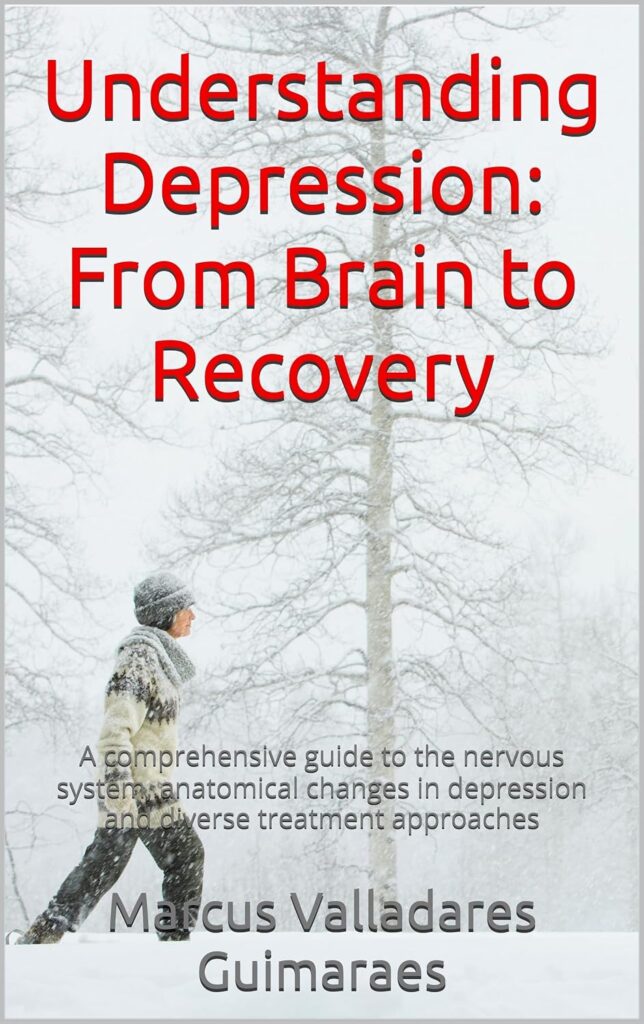
“Understanding Depression: From Brain to Recovery” is an accessible scientific guide that explains depression from neuroanatomy to healing strategies. You will discover how specific brain structures, including the hippocampus, amygdala and prefrontal cortex, are involved in the illness, the different forms of depression and a comprehensive overview of treatments beyond medications. The book dedicates particular attention to physical activity as a neurobiological ally and to Viktor Frankl’s logotherapy for finding meaning in difficulties. Written with clear and rigorous language, it offers practical tools to recognize and address depression, whether for personal experience or to help those you love.
Discover the Complete Guide – Begin Your Journey of Understanding
© 2025 Alice & Marcus Guimarães. All rights reserved.This site is proudly created with WordPress.