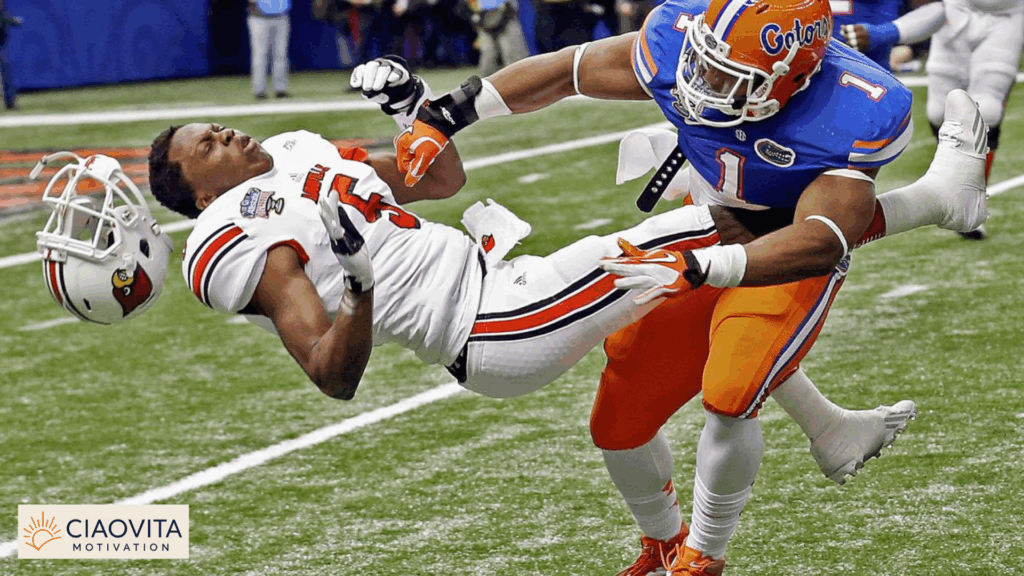
HeadImpact inFootball – What ScienceReveals About Player Safety.
Understanding the Reality of Head Impacts on the Field
Every fall, millions of young athletes suit up for football, unaware that they will experience hundreds of head impacts throughout their season. Recent scientific research has finally quantified exactly what happens when players collide on the field and the numbers are eye opening. Head impact research using advanced helmet sensors has transformed our understanding of what athletes experience during games and practices, revealing patterns that challenge many assumptions about youth versus college football and the role of concussion history in predicting future outcomes.
The average high school football player sustains approximately 650 impacts to the head during a single season. To put this in perspective, that translates to roughly 46 impacts per week or about 6 to 7 head impacts every single day for 14 consecutive weeks. One extreme case documented a player who experienced 2,235 impacts in a single season, an average of 22 impacts per day. These figures are not meant to alarm but to inform, as most of these impacts occur at relatively low magnitudes that fall well below concussion causing levels.
How Scientists Measure Head Impact
Understanding head impact requires grasping some basic physics concepts, though nothing too complicated. When we talk about head impacts in football, scientists measure how quickly the head changes velocity, which is called acceleration. Think of it this way: when you’re in a car that suddenly stops, your body lurches forward not because of the speed you were traveling, but because of the rapid change in speed. The same principle applies to the head during football collisions.
Two types of acceleration matter most for head injuries. Linear acceleration describes straight-line motion, like pushing someone directly backward. This type of acceleration compresses brain tissue and creates pressure gradients inside the skull. Rotational acceleration describes twisting motion around a fixed point, similar to unscrewing a jar lid. This rotation causes shearing forces that can damage delicate brain neurons. Scientists measure linear acceleration in “g” units (where 1g equals the force of gravity) and rotational acceleration in radians per second squared.
Modern technology has made measuring these forces possible through a system called the Head Impact Telemetry (HIT) System. This device consists of six small accelerometers embedded between the padding of a standard football helmet. These sensors spring mount inside the helmet and record data 1,000 times per second whenever an impact exceeds a threshold of 14.4g. The information transmits wirelessly to a sideline computer up to 150 yards away, capturing every significant hit throughout games and practices without interfering with normal play.
The Numbers Tell an Interesting Story
Research tracking 95 high school athletes over four years revealed fascinating patterns about head impact exposure. During practices, players average about 9 impacts per session, while games roughly double that number to around 24 impacts. However, these averages hide significant differences between positions. Offensive and defensive linemen, who clash on every play, sustain approximately 11 impacts per practice and 29 per game. Compare this to quarterbacks, who experience about 3 impacts during practice but 26 during games or wide receivers and defensive backs, who see roughly 5 practice impacts and 16 game impacts.
The magnitude of these impacts also varies considerably. The typical head impact during high school football produces about 25g of linear acceleration and 1,627 radians per second squared of rotational acceleration. Game situations generate slightly higher forces than practices, averaging 26g linear and 1,711 rotational compared to 24g and 1,554 during practice sessions. However, most impacts fall on the lower end of the spectrum, with 75% producing 30g or less of linear acceleration.
What makes these findings particularly interesting is how they compare to college football. You might assume college players, who are bigger, faster and stronger, would experience dramatically different impacts. Surprisingly, high school athletes actually sustain more total impacts per season than their college counterparts. College players record between 257 and 438 impacts annually, compared to the 520 to 652 impacts high school players endure. This difference likely reflects variations in season length and practice structure rather than any fundamental difference in playing style.
The Concussion Threshold Puzzle
One of the biggest questions in sports medicine concerns the biomechanical threshold for concussion. In other words, at what point does a head impact cause a concussion? Despite extensive research, no investigation has identified a clear set of variables that reliably predicts concussion with high accuracy. This complexity exists because concussions involve numerous factors beyond simple impact magnitude, including an athlete’s genetic profile, hydration status, fatigue level, anticipation of the hit, neck muscle activation and even recent sleep quality.
Available evidence suggests concussions typically occur when linear acceleration exceeds approximately 95 to 100g and rotational acceleration surpasses 5,500 radians per second squared, with the impact occurring to the front, side, or top of the helmet. Research on 13 concussed high school athletes found these injuries occurred within a range of 74 to 146g linear and 5,583 to 9,516 radians per second squared rotational acceleration. College athletes show remarkably similar thresholds, with concussions averaging about 103g linear and 5,312 radians per second squared rotational.
The similarity in concussion thresholds between high school and college players presents an intriguing puzzle. College athletes sustain significantly more high-magnitude impacts than high school players. Among the top 1% of hardest hits, college players experience 99g compared to 91g for high school players. Yet concussion rates hover around 5% at both competitive levels. This suggests college athletes may possess a higher tolerance for head impacts, though scientists remain uncertain why.
Does Concussion History Predict Future Problems?
Here’s where the story gets even more complicated. Many people assume that athletes with a history of previous concussions will experience worse outcomes if they sustain another concussion. This assumption seems logical, after all, wouldn’t previous brain injuries make the brain more vulnerable? However, a comprehensive systematic review of 16 studies involving over 4,800 college athletes revealed something surprising: the evidence remains mixed and inconclusive.
Among the studies examining whether prior concussion history predicts worse outcomes from a subsequent concussion, less than half (about 44%) reported statistically significant associations. When researchers looked specifically at symptom duration, how long symptoms last after a concussion, only about 31% of studies found that prior concussion history made a difference. Similarly, only about 29% of studies found that athletes with previous concussions took longer to return to play.
These findings don’t mean concussion history is irrelevant. Rather, they suggest the relationship is far more nuanced than we previously thought. Several factors complicate the picture. First, many studies simply asked whether athletes had any prior concussions (yes or no) rather than tracking the exact number. An athlete with one previous concussion might respond very differently than one with three or more. Second, few studies collected detailed information about those prior concussions, when they occurred, how severe they were or how long recovery took. Third, concussion management practices have changed dramatically over the past 15 years, becoming much more conservative. This means longer return-to-play times in recent years might reflect cautious medical management rather than actually worse injuries.
Some intriguing patterns did emerge from the research. Studies that tracked concussions occurring during the study period (rather than relying on athletes’ memories of old injuries) more frequently found associations between concussion history and worse outcomes. About 56% of these studies showed connections, compared to only 25% of studies that relied on remote concussion history. This suggests that recent concussions might matter more than distant ones, though more research is needed to confirm this pattern.
The Role of Multiple Concussions
While having any prior concussion doesn’t reliably predict worse outcomes, having multiple prior concussions might be different. Some research suggests that athletes with three or more previous concussions may face increased risks. In one study of collegiate athletes, those with a history of three or more concussions experienced longer recovery times than those with only one or two previous concussions. However, this research remains preliminary, and many studies lack sufficient numbers of athletes with multiple concussions to draw firm conclusions.
The challenge lies in understanding not just how many concussions an athlete has sustained, but the complete picture of their concussion history. Important factors might include the age when they sustained their first concussion, how much time has passed since the most recent concussion, how severe those previous concussions were, and how long recovery took. Unfortunately, most studies included in the review didn’t collect this detailed information, leaving many questions unanswered.
What This Means for Young Athletes and Families
Understanding head impact exposure and concussion history should inform decision-making without creating unnecessary fear. Football, like all contact sports, carries inherent risks that participants and families must weigh against the sport’s considerable benefits. These benefits include physical fitness, teamwork skills, discipline, leadership development and the pure enjoyment that comes from athletic competition. The goal of head impact research is not to eliminate football but to make it as safe as possible through evidence-based improvements.
Parents should understand that the vast majority of head impacts occur at magnitudes well below concussion thresholds. About 75% of impacts produce less than 30g of linear acceleration, which scientific evidence suggests poses minimal immediate risk. Proper coaching that emphasizes technique over aggression significantly reduces high-magnitude impacts. Programs that limit full-contact practices and teach proper tackling fundamentals demonstrate lower injury rates.
For athletes with previous concussions, the current evidence doesn’t support the assumption that another concussion will automatically cause worse problems or longer recovery. While some athletes with multiple previous concussions may experience prolonged recovery, this isn’t universal. Each concussion remains an individual event influenced by numerous factors beyond just concussion history. Athletes, parents and medical professionals should consider concussion history as one factor among many when making decisions about sports participation and return to play, rather than viewing it as a definitive predictor of future outcomes.
The Future of Head Impact Research
Scientists continue working to better understand the complex relationships between head impacts, concussion history and long-term outcomes. Future research needs larger studies specifically designed to examine these questions, better methods for collecting detailed concussion history information, and longer follow-up periods to track athletes over time. Researchers also need to examine a broader range of outcomes beyond just symptom duration and return to play, including academic performance, mental health, and quality of life.
The science of head impact exposure has transformed from speculation to precise measurement over the past two decades. This transformation represents genuine progress that continues improving safety for millions of athletes. By understanding what research reveals and acknowledging what remains uncertain, about head impact patterns and concussion history, we can all contribute to making football safer while preserving what makes the sport meaningful to those who play and love the game.
References
- Choi, G.B., Smith, E.P., Duma, S.M., Rowson, S., Campolettano, E., Kelley, M.E., Jones, D.A., Stitzel, J.D., Urban, J.E., Genemaras, A., Beckwith, J.G., Greenwald, R.M., Maerlender, A., & Crisco, J.J. (2022). Head Impact Exposure in Youth and Collegiate American Football. Annals of Biomedical Engineering, 50(11), 1488-1497.
- Broglio, S.P., Eckner, J.T., & Kutcher, J.S. (2012). Field-based measures of head impacts in high school football athletes. Current Opinion in Pediatrics, 24(6), 702-708.
- Gaudet, C.E., Iverson, G.L., Kissinger-Knox, A., Van Patten, R., & Cook, N.E. (2022). Clinical Outcome Following Concussion Among College Athletes with a History of Prior Concussion: A Systematic Review. Sports Medicine – Open, 8(1), 134.
© 2025 Alice & Marcus Guimarães. All rights reserved.This site is proudly created with WordPress.